
Free tool for contractors
Concrete calculator
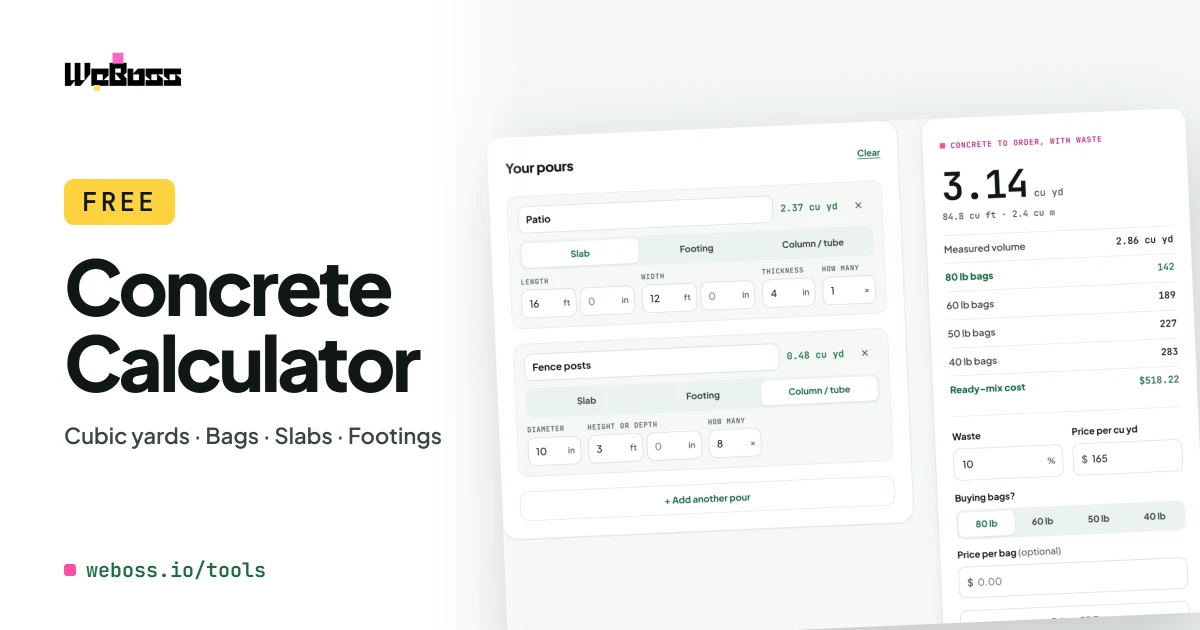
How much concrete do you need? Enter the slab, footing or column and get yards and bags.
Step by step
How to work out how much concrete you need
Pick the shape
A slab, a footing, or a round column or tube.
Enter the size
Length and width in feet, thickness or depth in inches.
Add every pour
Add a row for each slab, footing or set of posts.
Add waste
Add a percentage for spills and uneven ground.
Read yards and bags
Cubic yards for a truck, or the number of bags to buy.
What it does
A concrete slab, footing and bag calculator in one
A concrete yardage calculator for ready-mix and a concrete bag calculator for small pours, with the cost of both.
-
Concrete slabs
Patios, driveways and floors: length, width and thickness.
-
Footings
Strip footings by length, width and depth.
-
Columns and tubes
Round posts and form tubes by diameter and height.
-
Cubic yards and cubic feet
The volume to order from a ready-mix supplier, and in cubic meters.
-
40, 50, 60 and 80 lb bags
How many bags of mix the pour takes, by bag size.
-
Waste allowance
Add a percentage so the pour does not come up short.
-
Cost estimate
Type a price per cubic yard or per bag to see the cost.
-
Print or PDF
A one-page list of every pour and the totals.
The formulas
How concrete volume is calculated
- Slab: length × width × thickness, all in feet. 10 ft × 10 ft × 4 in is 33.3 cubic feet.
- Cubic yards: cubic feet ÷ 27. 33.3 cubic feet is 1.23 cubic yards.
- Footing: length × width × depth, with the inches divided by 12.
- Column or tube: 3.1416 × radius × radius × height.
- Bags: cubic feet ÷ the bag's yield, rounded up to a whole bag.
- Waste: the volume × (1 + waste %). The calculator starts at 10%.
It is an estimate. Check the yield printed on your bag, your supplier's minimum order and your local building code. To measure the area first, use the square footage calculator.
Concrete bags per cubic yard
| Bag | Makes | Bags per cu yd | 10 × 10 slab, 4 in |
|---|---|---|---|
| 80 lb | 0.6 cu ft | 45 | 56 bags |
| 60 lb | 0.45 cu ft | 60 | 75 bags |
| 50 lb | 0.375 cu ft | 72 | 89 bags |
| 40 lb | 0.3 cu ft | 90 | 112 bags |
Yields as printed on ready-mix bags. A 10 × 10 ft slab 4 inches thick is 1.23 cubic yards before waste.
Who it is for
A concrete calculator for contractors and weekend pours
Concrete and paving contractors
Total a job with several pours and order the right yardage.
Builders and fence installers
Count the bags for footings and post holes.
Homeowners
Find out whether a patio or path is a few bags or a truck.
How do I calculate how much concrete I need?
Multiply length by width by thickness, all in feet, to get cubic feet, then divide by 27 for cubic yards. A 10 by 10 foot slab that is 4 inches thick is 10 × 10 × 0.333 = 33.3 cubic feet, or 1.23 cubic yards.
How many bags of concrete are in a cubic yard?
About 45 bags of 80 lb mix, 60 bags of 60 lb, 72 bags of 50 lb or 90 bags of 40 lb. Those come from the yields printed on the bags: 0.60, 0.45, 0.375 and 0.30 cubic feet each.
How many bags of concrete do I need for a 10x10 slab?
At 4 inches thick a 10 by 10 foot slab is 33.3 cubic feet, which is 56 bags of 80 lb mix or 75 bags of 60 lb, before waste. Many people order ready-mix for a pour that size.
How much extra concrete should I order?
A common rule of thumb is 5 to 10 percent, to cover spills, uneven ground and forms that bow. The calculator starts at 10 percent and you can change it.
How do I calculate concrete for a footing?
Multiply the footing's length in feet by its width and depth, with those two converted from inches to feet. A footing 40 feet long, 16 inches wide and 8 inches deep is 40 × 1.33 × 0.67 = 35.6 cubic feet, or 1.32 cubic yards.
How do I calculate concrete for a round column or tube?
Multiply 3.14 by the radius squared by the height, all in feet. A 12-inch tube 4 feet deep is 3.14 × 0.5 × 0.5 × 4 = 3.14 cubic feet, which is 6 bags of 80 lb mix.
How thick should a concrete slab be?
Four inches is common for patios and walkways, and driveways and slabs that carry heavy loads are usually thicker. The right thickness depends on the load, the soil and your local building code, so check before you pour.
Get started